Publication date: October 22, 2026 | BIKOSYS Digital Solutions
Imagine a roofing company in Texas with a professional website, genuine customer reviews, and years of experience. Its site appears for some Google searches, yet when an owner asks ChatGPT to suggest contractors nearby, the company is missing. Does that mean ChatGPT blocked the business? Not necessarily. An AI answer is not an exhaustive directory. But sometimes the absence reflects a real technical issue that prevents crawlers from accessing important information.
If ChatGPT can’t find your website, investigate discoverability before buying another expensive batch of content or redesigning the entire site. This guide walks through 12 technical and commercial checks for US businesses using WordPress, Cloudflare and other website platforms.
First, understand what “not showing up” means
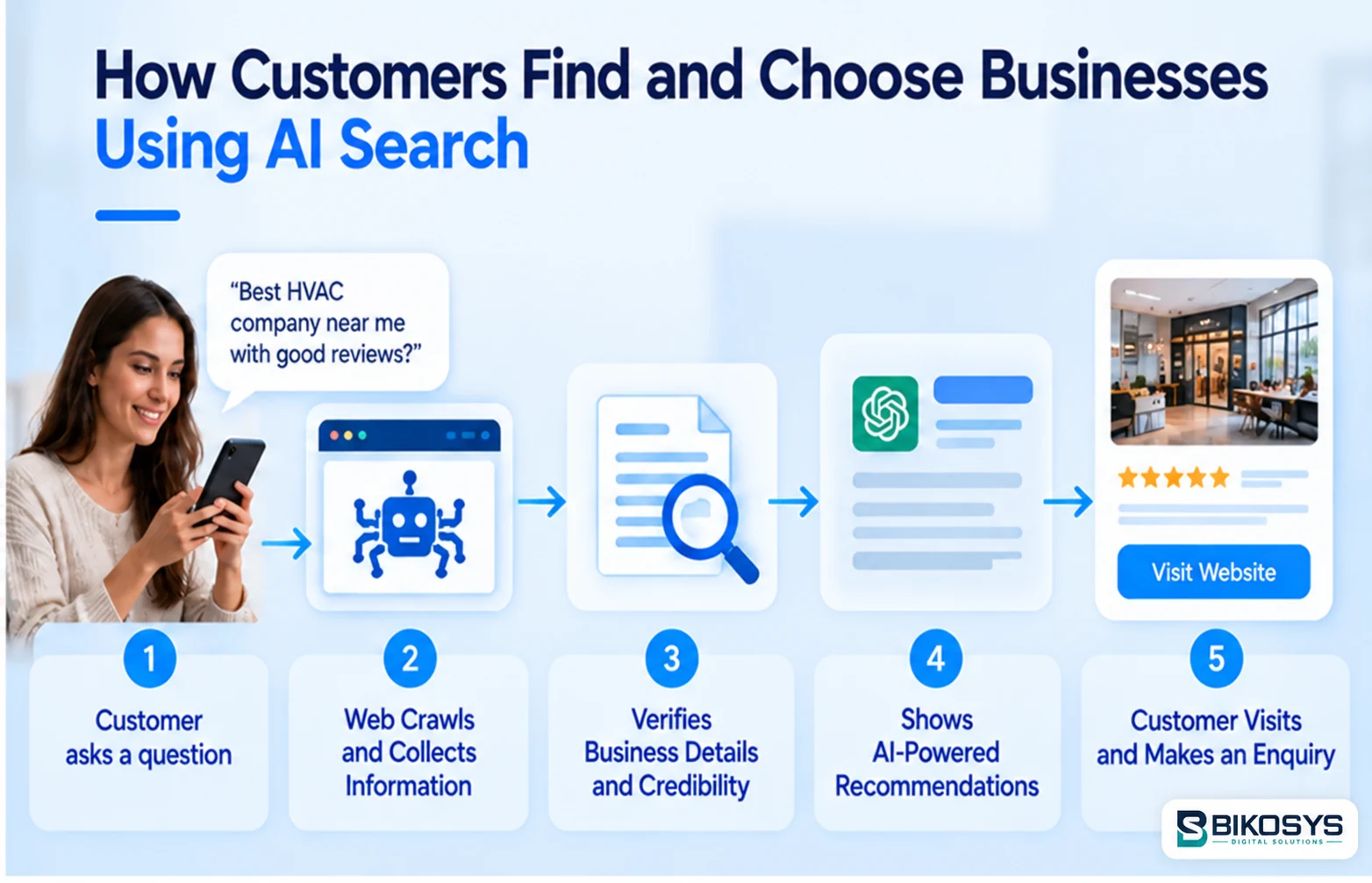
Three situations are often confused. Inaccessible: a search-enabled assistant’s crawler cannot retrieve pages because of restrictions or errors. Accessible but not recommended: the website can be found, but isn’t relevant enough to a particular query or answer. Mentioned but no enquiries: visibility is present but the offer, landing pages, or conversion journey isn’t persuasive. Each requires a different response.
| Observation | First investigation |
|---|---|
| Site cannot be retrieved | Server, robots.txt, CDN and firewall |
| Pages absent from Google | Indexing, canonicals, content and navigation |
| AI misstates the services | Service-page clarity and accurate public business information |
| Business absent from recommendation | Query relevance, independently verifiable evidence and sources |
| AI referral visits but no leads | Landing-page quality, trust, forms and tracking |
For the broader context, read why businesses become invisible in AI search.
1. Check access for OpenAI’s search crawler
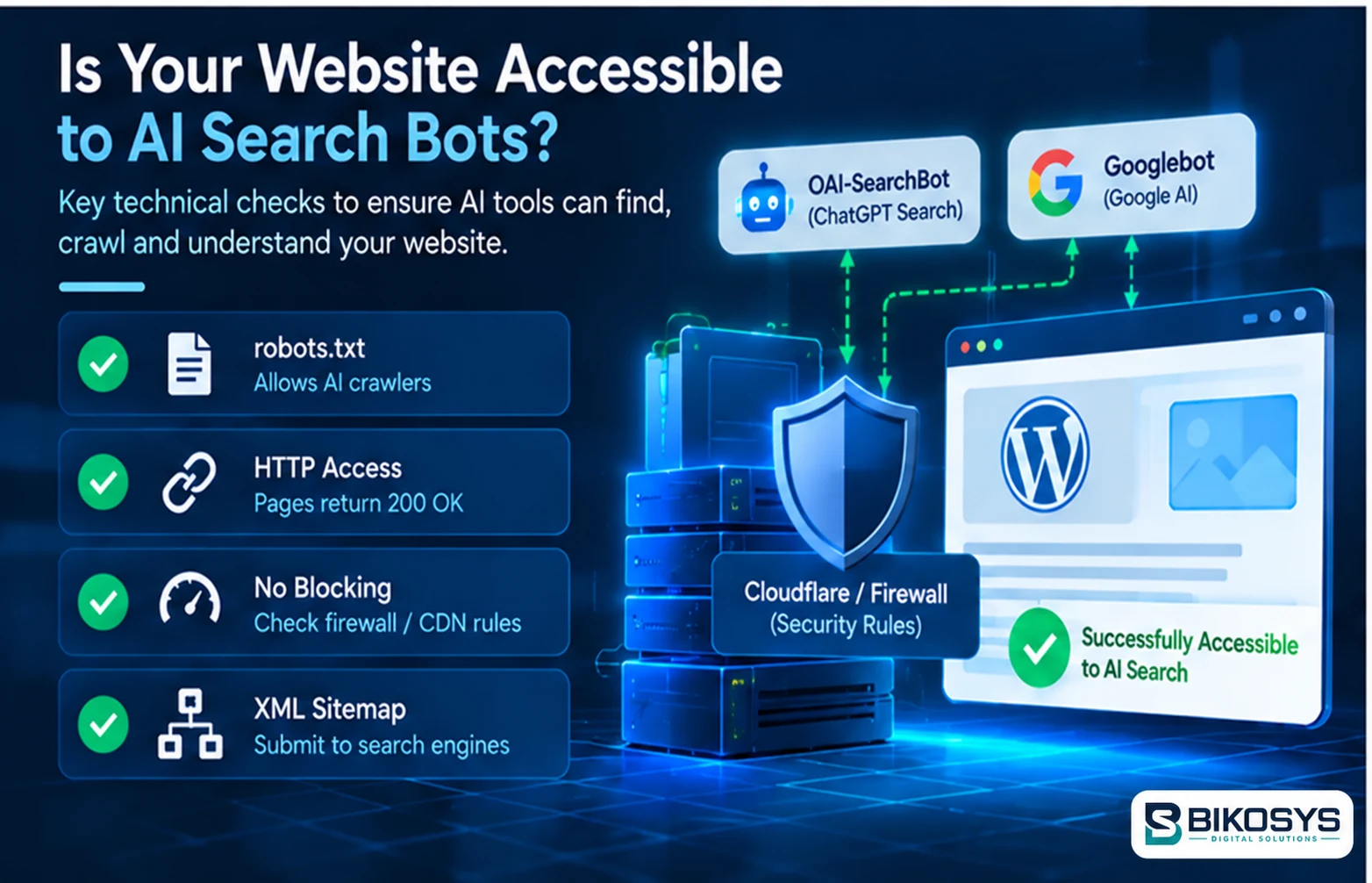
OpenAI identifies OAI-SearchBot as a crawler used for ChatGPT search. It is distinct from GPTBot, which is associated with content that may be used to train AI models. Businesses can make separate choices about these crawlers. See OpenAI’s official crawler guidance.
Review bot directives, CDN events and logs for verified OAI-SearchBot requests. Allowing Googlebot does not necessarily mean another crawler is allowed. Nor does allowing search discovery require granting every AI crawler identical permissions.
2. Inspect robots.txt
Visit https://yourdomain.com/robots.txt. A rule such as:
User-agent: *
Disallow: /
instructs compliant crawlers not to crawl the website. It may have been copied accidentally from a staging environment. For a public site, a broadly permissive example is:
User-agent: *
Allow: /
These are illustrations, not universal configurations. Review other directives and protect private areas using authentication rather than relying on robots.txt as security. Correct only verified mistakes.
3. Review Cloudflare, firewall and bot challenges
A site can load in a browser yet return HTTP 403, 429, CAPTCHA, or a JavaScript challenge to crawlers. In Cloudflare, review Security Events, bot settings and WAF rules for affected paths and time windows. Compare IP evidence against OpenAI’s official crawler information; user-agent names alone can be spoofed.
Never turn off the whole firewall to improve SEO. Make narrowly scoped exceptions for verified legitimate traffic, preserving protection against abuse. New content cannot compensate for blocked crawlers.
4. Verify Google indexing of priority pages
Google AI Overviews and AI Mode relate to Google Search, which uses different ranking and crawling systems from ChatGPT. Google’s AI features documentation explains that normal Google Search eligibility is fundamental for supporting links in AI-powered experiences.
In Google Search Console’s URL Inspection, check index status, crawl accessibility, noindex directives, rendered content, the Google-selected canonical, server errors, and redirects. Inspect commercial service pages individually: an indexed homepage does not substitute for a missing HVAC maintenance or WordPress support page. Google indexing does not guarantee ChatGPT inclusion.
5. Check WordPress and Rank Math indexing settings
In WordPress → Settings → Reading, verify that the live site isn’t discouraging search engines. In Rank Math, inspect index/noindex, canonicals, sitemaps, redirects and SEO titles for important pages. Also check security plugins and custom configuration layers that might change the public response. After migration from staging, these settings can be unintentionally retained.
Test what a crawler receives, rather than relying only on what the admin interface says. See our SEO-friendly web design checklist.
6. Test status codes, redirects and canonical tags
Public pages intended to be indexed should generally load successfully and expose their intended content. Investigate 200 responses with unexpectedly empty content, 301/308 redirect destinations and chains, 403 access restrictions, 404 missing pages, 429 rate limiting and 5xx server errors.
Ensure canonical tags identify the intended original page. A detailed new service page that canonically points to a generic older page sends confusing signals. Fix root causes, not just SEO plugin warnings.
7. Replace vague copy with specific service information
A weak page says, “We deliver innovative solutions with exceptional quality.” That could describe almost any company. A stronger hypothetical statement says, “We provide commercial rooftop HVAC replacement and preventive maintenance for medical offices, retail properties and light industrial buildings in Dallas–Fort Worth.” It states the service, customer and real coverage.
Create distinct service pages only where the offerings warrant useful separate explanations. Each should say what the service includes, which problems it solves, who benefits, how delivery works, what genuine proof exists, and how to enquire. Avoid nearly identical pages targeting dozens of cities.
| Page section | Reader question answered |
|---|---|
| Clear heading and opening | What exactly do you offer? |
| Problems solved | Is it relevant to my need? |
| Scope and process | What will happen? |
| Customer type and geography | Do you serve people like me? |
| Evidence and FAQs | Why should I trust you? |
| Enquiry CTA | How do we start? |
8. Use accurate structured data, not AI-ranking tricks
Schema markup provides machine-readable factual context. Relevant types can include Organization, appropriate LocalBusiness, Service, Article/BlogPosting and BreadcrumbList. The information should match visible content and actual company details. Schema can support certain search features but does not guarantee AI citations.
Google says special AI-specific markup isn’t required for its AI features. Do not invent US addresses, testimonials or review ratings to appear relevant. Keep visible FAQs because they help readers, not to chase deprecated FAQ rich results. See Google’s structured-data guidelines.
9. Correct inconsistent business information
Consider a hypothetical company whose website uses one trading name, social profile another, and an old directory lists a disconnected phone number. Customers cannot easily verify which details are current. Review website, professional profiles and applicable directory listings for accurate company name, domain, services, contact channels and legitimate location or service areas.
Maintain a Google Business Profile only if eligible. Remote-only businesses should not invent physical offices or service locations to win local rankings. Accuracy matters more than repeating the same marketing paragraph everywhere.
10. Back promises with genuine evidence
“The best web agency in America” is unsupported promotional language. A specific list of deliverables—responsive WordPress development, technical SEO configuration, conversion-focused service pages, maintenance and handover—is more informative. Real projects, verified reviews, screenshots, authentic credentials, staff details and transparent scope can demonstrate reliability.
Proof-to-promise test: For every major claim, ask: “What can the customer independently inspect?” Remove or qualify statements without support. Never fabricate Bikosys outcomes or client statistics.
11. Connect educational and commercial pages with internal links
A useful journey might be Homepage → Services → Individual service → Related advice → Contact. A visitor evaluating a redesign may benefit from website refresh vs. redesign vs. rebuild. A reader losing enquiries may benefit from why websites don’t generate leads.
Use descriptive link text and link only when the destination answers a natural next question. Don’t add circular links merely to raise a plugin score. Make the most important commercial pages easy for visitors and crawlers to find.
12. Measure discovery alongside qualified enquiries
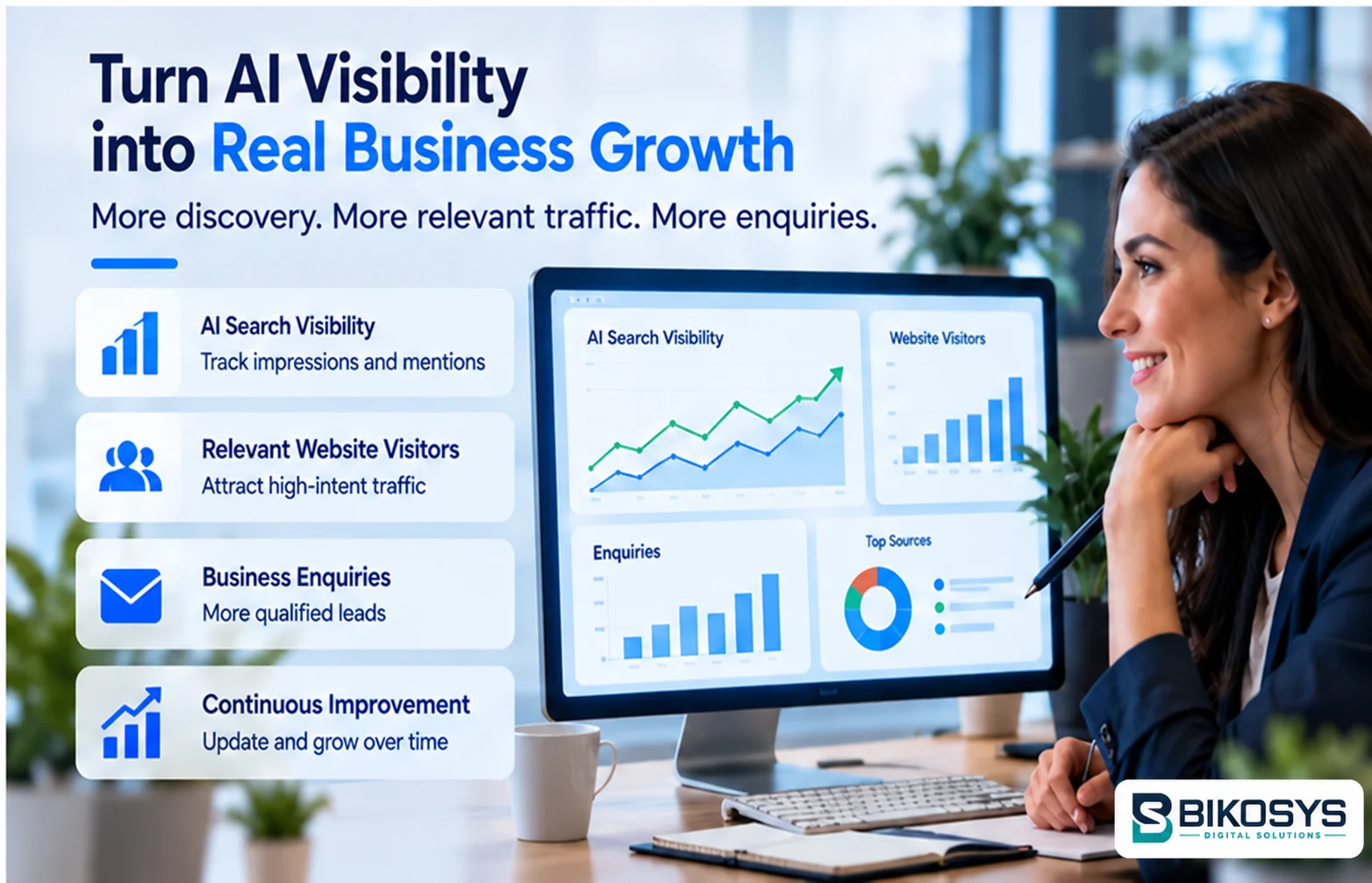
Use Google Search Console to examine impressions, clicks, indexing and page-level performance. Google’s AI search experiences don’t provide a comprehensive separate report of each AI Overview appearance. Use GA4 to inspect attributable AI-search referrals and engagement; ChatGPT search can append utm_source=chatgpt.com on outbound links, but attribution is not complete.
Track enquiry forms, relevant emails, calls and actual sales where attribution is available. Manual tests can compare a controlled set of representative buyer questions, but responses vary by wording, geography, time and product. One missing result is not proof of failure.
A few qualified leads can be more valuable than thousands of irrelevant informational visitors.
A practical 30-day AI search readiness plan
| Week | Priority | Deliverable |
|---|---|---|
| 1 | Accessibility | Verify robots.txt, OAI-SearchBot, CDN events, HTTP responses and WordPress settings |
| 2 | Google discovery | Inspect priority URLs, canonicals, redirects, sitemap and navigation |
| 3 | Sales content | Improve two or three money pages and add genuine proof and accurate business information |
| 4 | Measurement | Review analytics, qualified enquiries and repeatable AI-search observations |
For limited budgets, prioritize verified technical blockers first, important revenue-generating pages second, authentic evidence and site structure third, and additional content only where it adds distinct value.
Mistakes that won’t fix AI visibility
Guaranteed recommendation offers: Nobody can promise particular organic ChatGPT recommendations. AI-only files: Google doesn’t require special llms.txt files or magic AI schema. Mass duplicated content: Thin articles that repeat each other rarely help customers. Fake trust signals: Invented testimonials and locations can create serious reputational and policy risks. Turning off security: Make verified, targeted exceptions instead. Overinterpreting one result: AI answers are variable and not exhaustive directories.
Frequently asked questions
Why can’t ChatGPT find my business website?
Possible reasons include crawler blocks, firewall challenges, inaccessible URLs, unclear service content or the relevance of the particular query. Verify access before assuming a ranking problem.
How do I make my website visible to ChatGPT search?
Ensure public pages can be crawled, review OAI-SearchBot rules, avoid accidental restrictions, and maintain relevant, accurate content. These steps improve accessibility but don’t guarantee recommendations.
Can I pay ChatGPT to recommend my business organically?
Advertising arrangements should not be confused with purchasing an organic recommendation. Don’t trust offers promising guaranteed editorial citations.
Does Google indexing guarantee a ChatGPT recommendation?
No. The platforms have different discovery and answer systems. Google indexing is not a ChatGPT placement guarantee.
Can Cloudflare block ChatGPT crawlers?
Yes. WAF rules, rate limiting and bot challenges can affect crawlers. Examine real security logs and verify identity before adjusting rules.
Does schema guarantee AI visibility?
No. Valid schema describes facts and may enable applicable search features; it doesn’t force a mention or recommendation.
Is AI search optimization different from traditional SEO?
User experiences and answer presentation differ, but discoverability, helpful information, website structure, trust and conversions remain core principles.
How long does improving AI visibility take?
No universal timeline exists. Crawl and indexing updates, source selection and content assessment vary; measure progress instead of promising a fixed schedule.
Can small US businesses compete with larger companies?
Specialized services, credible evidence and focused answers can help small companies compete for relevant needs, but inclusion is never assured.
Do I need a complete redesign?
Not automatically. A targeted technical repair or service-page improvement may be enough. Consider redesign when the broader user experience, structure or technology is genuinely holding the business back.
Final thoughts: become accessible, understandable and worth choosing
If ChatGPT can’t find your business website, don’t immediately invest in another large AI SEO campaign. Confirm that crawlers can access the important pages, search engines can index them, customers understand the services, claims are credible and visitors can enquire easily.
The objective isn’t to manipulate a chatbot into repeating a company name. It is to build a technically accessible, useful and trustworthy site that helps people make informed decisions across AI and traditional search.
Not sure whether AI search tools can discover your business?
BIKOSYS Digital Solutions helps businesses examine search accessibility, WordPress and website issues, technical SEO, structured data, service-page content and conversion opportunities. Rather than proposing a full redesign without diagnosis, the first step is identifying the actual problems.
Discuss your website and AI search visibility goals with BIKOSYS.
Editorial references
- Google — AI features and your website
- Google — Structured data guidelines
- OpenAI — Overview of OpenAI crawlers