If you are researching website redesign cost USA businesses can expect in 2026, you will quickly discover that pricing varies enormously from one project to another.
Ask five web design companies for quotes and the gap can be even wider.
That does not automatically mean somebody is overcharging. The phrase website redesign covers everything from improving the visual presentation of a small five-page website to rebuilding the structure, content, SEO foundation and conversion journey of a large ecommerce or B2B site.
So if you are trying to understand website redesign cost in the USA in 2026, the most useful answer is not a single number.
It is understanding what you are actually buying.
A redesign that improves appearance but ignores search visibility, mobile usability, content, conversion paths and technical debt may be inexpensive at launch and expensive six months later. A more strategic project may cost more initially because it is solving a larger business problem.
This guide breaks down realistic planning ranges, the factors that influence pricing, the hidden costs businesses often overlook, and how to compare website redesign proposals without choosing on price alone.
How Much Does a Website Redesign Cost in the USA in 2026?
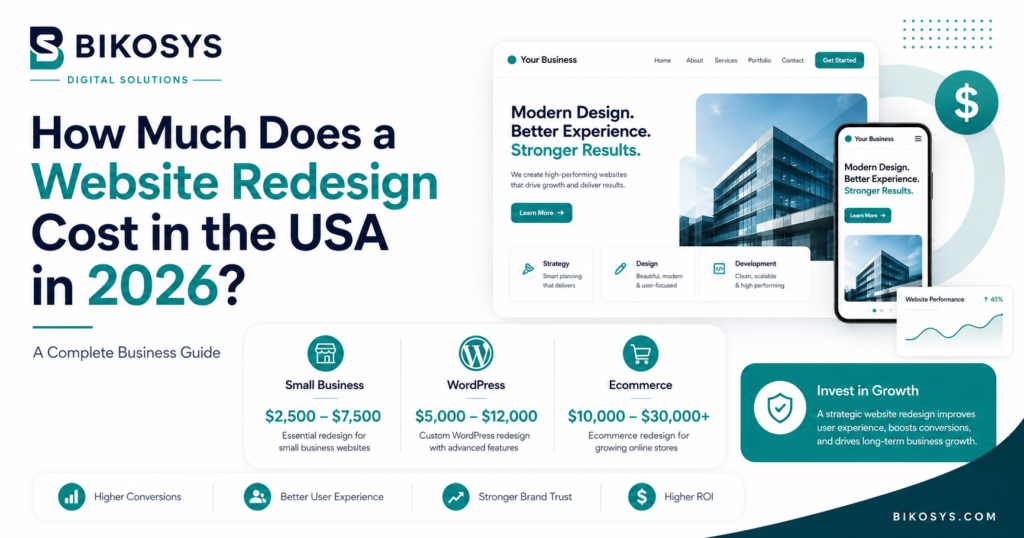
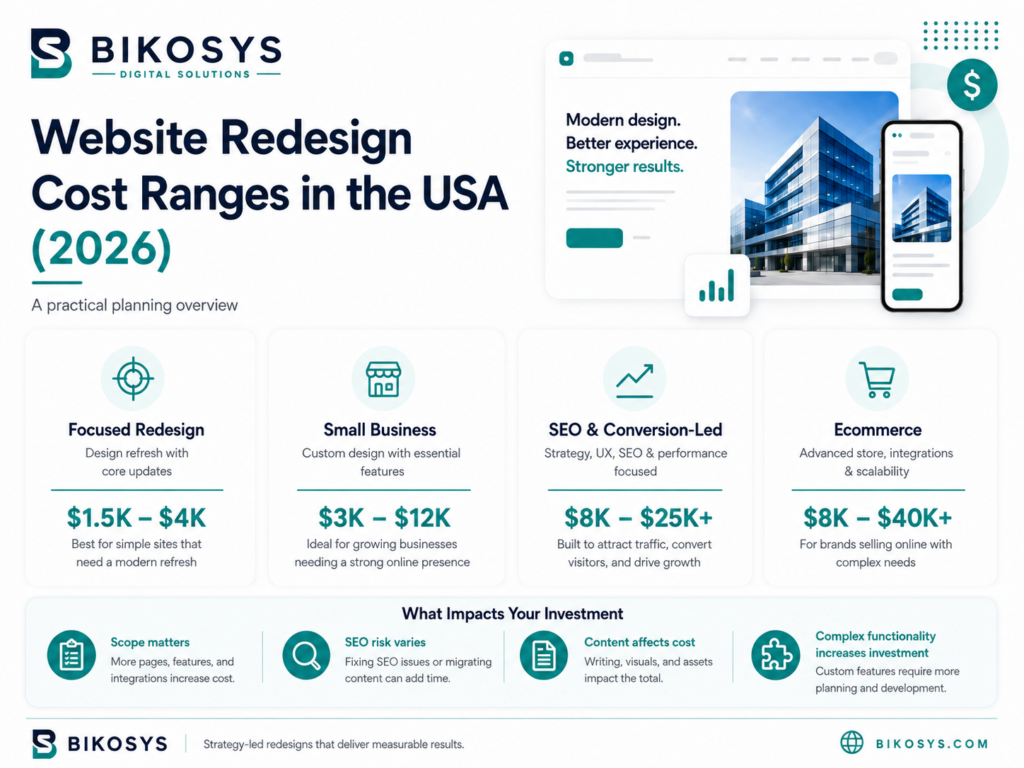
For planning purposes, a professional redesign for a US business can range from roughly $1,500 for a focused small-site redesign to $25,000 or considerably more for projects involving custom UX, ecommerce, complex integrations, large content migrations or substantial development work.
These are planning ranges rather than universal market prices:
| Type of Website Redesign | Practical 2026 Planning Range | Best Suited For |
|---|---|---|
| Focused visual / content redesign | $1,500–$4,000 | Small websites with a healthy technical foundation |
| Professional small-business redesign | $3,000–$12,000 | Service businesses needing stronger UX, mobile design, trust and lead generation |
| Conversion and SEO-led redesign | $8,000–$25,000+ | Established B2B or service brands with strategic content and organic visibility requirements |
| Ecommerce website redesign | $8,000–$40,000+ | WooCommerce, Shopify and online stores with catalog, checkout, migration or conversion work |
| Complex rebuild / custom platform | $20,000–$100,000+ | Portals, web applications, large websites and businesses with custom integrations |
A ten-page brochure website and a 2,000-product ecommerce store are both “websites,” but they are not remotely the same project. That is why comparing redesign quotes without comparing scope is misleading.
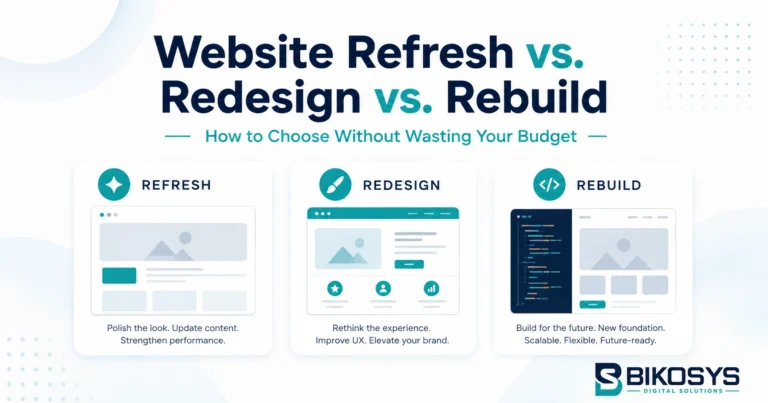
If you are already considering a major change, our guide on whether to refresh, redesign or rebuild your website can help determine how much intervention the current site actually needs.
What Does “Website Redesign” Actually Include?
This is where many pricing comparisons go wrong.
One proposal may define redesign as changing the theme, colors, fonts and page layouts. Another may include customer research, information architecture, copy refinement, conversion planning, technical SEO, content migration, redirect mapping, analytics, performance optimization and post-launch support.
Both proposals may use the same word: redesign.
They are not selling the same outcome.
- Visual design and brand presentation
- Homepage and service-page restructuring
- Navigation and information architecture
- Mobile and responsive experience
- Calls to action and conversion paths
- Content editing or copywriting
- SEO preservation and on-page optimization
- Page-speed improvements
- CMS or theme replacement
- Forms, CRM and third-party integrations
- Ecommerce catalog and checkout work
- Analytics and conversion tracking
- Accessibility improvements
- Security, backup and staging processes
- Training and post-launch support
A professional website redesign service should therefore begin with the problems the business needs to solve, not with a predetermined template.
What Determines Website Redesign Cost?
There are several major cost drivers. Understanding them makes it much easier to evaluate a quote intelligently.
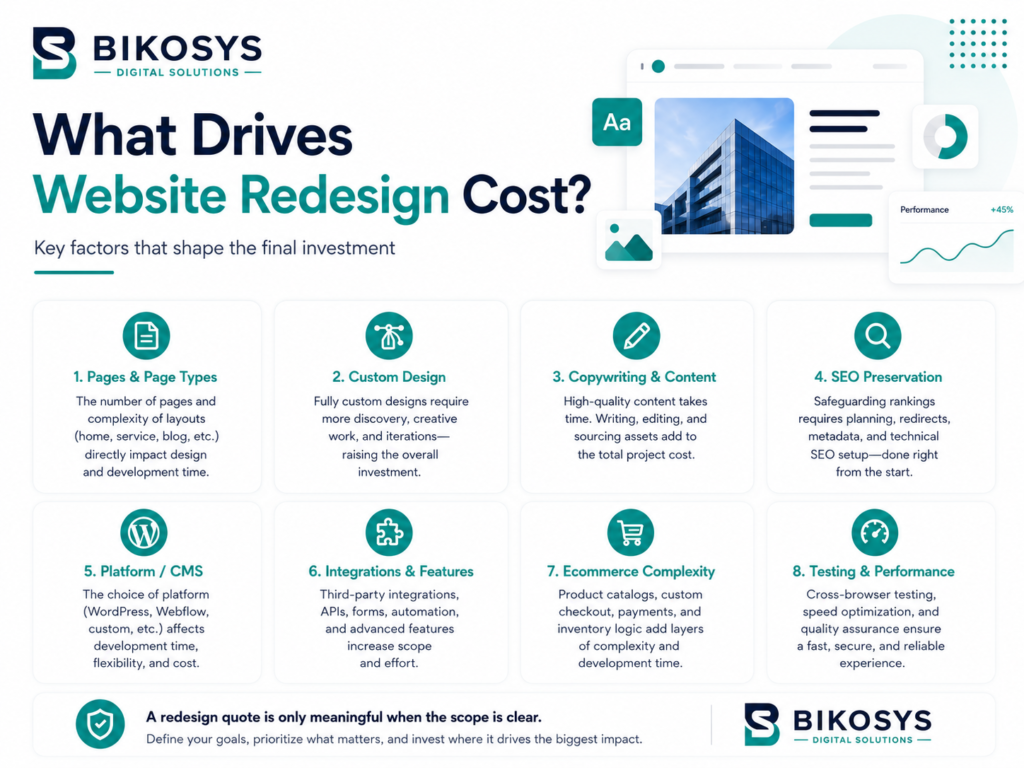
1. Number of Pages and Page Types
Page count matters, but page type matters more.
Twenty pages built from three reusable layouts may require less work than eight pages where every page has a different purpose, content structure and conversion journey.
A homepage, service page, location page, case study, product page and resource hub each solve a different communication problem. Strategic page planning takes time before visual design even begins.
2. Custom Design vs. Template Adaptation
A good template can be an efficient starting point for the right business. There is nothing inherently wrong with using one.
The problem appears when the business is forced into the template instead of the template being adapted around the business.
Custom design generally costs more because the team is making more decisions around hierarchy, brand, content, navigation, interaction and conversion. That additional work should have a purpose. Custom animation for its own sake is not strategy.
3. Content and Copywriting
Many redesign projects discover that the old design was not the only problem.
The service descriptions may be vague. Important pages may be missing. The homepage may speak mostly about the company instead of the customer’s problem. Calls to action may be generic. Years of new services may have been added without any clear hierarchy.
Good design cannot permanently compensate for weak content.
If copy needs to be researched, rewritten and structured around commercial search intent, that work belongs in the project budget.
4. SEO Preservation and Search Strategy
This is one of the most important differences between a cosmetic redesign and an SEO-friendly website redesign.
An established website may already have valuable rankings, backlinks, indexed pages and search history. Changing URLs, deleting useful content, replacing headings or publishing an incomplete migration can damage that value.
A redesign with organic traffic at stake should consider:
- Existing organic landing pages
- URLs that currently rank or receive links
- Redirect mapping
- Internal links
- Canonical URLs
- Metadata
- Structured data
- Indexing directives
- XML sitemaps
- Content that should be retained, improved or consolidated
Our SEO services and SEO-friendly website design approach are built around the idea that search visibility should be protected during design changes rather than repaired after launch.
5. Platform and CMS
A redesign that stays on the existing CMS is usually simpler than a project that changes platforms.
Moving from one system to another may require content migration, URL changes, form rebuilding, integrations, user-account migration, product data, redirects and new editorial workflows.
At that point the project is moving closer to a rebuild than a visual redesign.
For businesses with deeper technical requirements, website development services may be more appropriate than repeatedly extending a platform that has reached its practical limit.
6. Integrations and Functionality
Booking systems, membership tools, CRM connections, payment gateways, quoting tools, gated resources, multilingual content, custom calculators and APIs can change the project substantially.
Do not judge functionality by how small it looks on the screen. A simple-looking form can involve complex validation, automation, routing and data handling behind the scenes.
7. Quality Assurance, Accessibility and Performance
The work is not finished when the desktop homepage looks good.
A professional launch should include testing across real screen sizes, forms, navigation, links, browsers, performance and important user journeys. Accessibility should be considered during design and development rather than treated as a last-minute plugin.
Small Business Website Redesign Cost in the USA
When comparing website redesign cost USA businesses should look beyond the headline price and examine exactly what the proposed scope includes. For a typical service business, the most common buying question is not “How much can a website possibly cost?”
It is:
What level of investment is sensible for the website we actually need?
A local contractor, consulting firm, medical practice, manufacturer and professional-services company may all have relatively small websites, yet very different sales journeys.
A small business website redesign cost tends to rise when the project moves from presentation into strategy: dedicated service pages, stronger search targeting, conversion-focused content, case studies, location pages, integrations and measurement.
If the existing website is structurally healthy and the problem is mainly presentation, a focused redesign may be enough. If the site receives traffic but does not create inquiries, the project should investigate why before changing the design.
Our article on a website not generating leads explains many of the issues that can sit underneath an apparently simple redesign request.
How Much Does a WordPress Website Redesign Cost?
A WordPress website redesign cost depends heavily on the condition of the existing installation.
A clean, well-maintained WordPress site with a modern theme and sensible content structure can often be redesigned efficiently.
An older site may contain years of plugin dependencies, abandoned page-builder shortcodes, outdated PHP requirements, duplicated content, fragile custom code and a theme nobody wants to update because something may break.
Those sites should not be priced only by counting pages.
The developer first needs to determine what can safely be retained.
Sometimes redesigning within WordPress is the most practical route. Sometimes rebuilding the theme or site structure creates a cleaner long-term result. The correct depends on technical condition, not on the age printed in the footer.
Ecommerce Website Redesign Cost: Why Online Stores Cost More
An ecommerce redesign is not simply a business website with a shopping cart added.
The customer journey includes discovery, category navigation, search, filtering, product evaluation, trust, cart, checkout, payment, shipping and post-purchase communication.
The project may also involve:
- Product and category migration
- Variation and attribute structures
- Inventory systems
- Shipping rules
- Tax configuration
- Payment gateways
- Discount logic
- Subscriptions or memberships
- Reviews
- Analytics and ecommerce tracking
- Structured product data
- SEO preservation for category and product URLs
That is why ecommerce website redesign cost is normally higher than a similarly sized brochure site. The store is not simply publishing information; it is processing revenue.
Our ecommerce website development work treats usability, product discovery, technical reliability and conversion as parts of the same system.
Why Can One Redesign Quote Be $2,000 and Another Be $20,000?
Price does not automatically equal quality.
A smaller specialist may have lower overhead and produce excellent work. A large agency may charge more because the project includes research, strategy, several specialists and a longer quality-assurance process.
The important question is not, “Why is one number higher?”
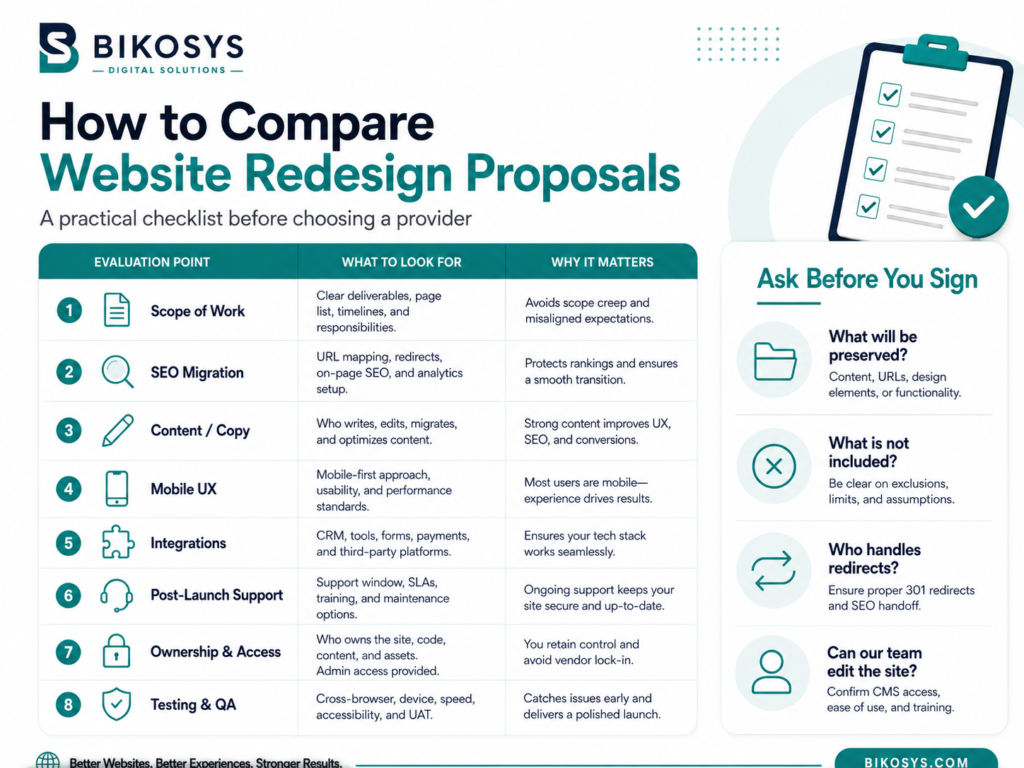
Ask:
- Are both teams solving the same problem?
- Are they redesigning the same number and type of pages?
- Is copywriting included?
- Is SEO migration included?
- Is mobile design planned separately or simply inherited?
- Are integrations included?
- Is performance optimization included?
- Who handles content migration?
- Who tests forms, redirects and analytics?
- What happens after launch?
- Will your team be able to edit the site?
- Who owns the website, design files and accounts?
Two proposals can have completely different prices because one is selling production and the other is selling diagnosis, strategy, production and risk management.
Compare deliverables, responsibilities and outcomes before comparing totals.
Website Redesign Costs That Are Easy to Miss
The number at the bottom of the proposal is not always the complete cost of ownership.
Content Migration
Who moves existing pages, posts, images, products, PDFs and metadata? If this is not clearly assigned, it often becomes a stressful final-week task.
Premium Software and Licenses
The new website may depend on premium plugins, themes, booking tools or third-party services. Find out which subscriptions are recurring and who owns the licenses.
Hosting and Maintenance
A redesign does not eliminate the need for updates, backups, security checks and technical maintenance. Our website maintenance services are designed for the period after launch, when the site becomes a live business asset rather than a project under construction.
Photography, Video and Brand Assets
A strong design can still look generic if the visual material is weak. Original photography, product imagery, video and illustration may need their own budget.
Post-Launch Changes
Clarify what happens when the real-world team begins using the website. Does the project include a support period? What counts as a defect, and what counts as a new request?
Can a Website Redesign Hurt SEO?
Yes, if it is handled carelessly.
A redesign can improve organic visibility when it produces better content, clearer architecture, faster pages and stronger usability. But it can also cause a serious traffic decline when valuable URLs disappear, redirects are missed, internal links change without review or important pages accidentally become noindex.
The safest redesign process treats the existing website as an asset to audit, not something to erase.
Before launch, identify what already has SEO value. After launch, verify redirects, indexing, canonicals, sitemaps, analytics and important landing pages.
This work may not be visible in a design presentation, but it can be far more valuable than another animation on the homepage.
How Should a Business Set a Website Redesign Budget?
Start with the commercial role of the website.
A website used mainly to confirm legitimacy has a different value from a website responsible for generating qualified inquiries, supporting a sales team or processing ecommerce revenue.
Before requesting quotes, write down:
- What is wrong with the current site?
- What is already working and should be protected?
- Which services or products matter most?
- Who is the primary customer?
- What action should visitors take?
- Does the site currently receive meaningful organic traffic?
- Which integrations are essential?
- Who will manage the website after launch?
- What must the website support over the next two to three years?
Those answers make it easier for a website redesign company in the USA or an overseas digital partner serving US businesses to scope the work properly.
They also reduce the chance of paying for features the business does not need.
How to Choose a Website Redesign Company
A redesign partner should be able to talk about more than visual preferences.
Ask how they think about customers, mobile use, content, search visibility, migration, performance, ownership and post-launch maintenance.
Useful questions include:
- What would you preserve from our current website?
- What would you change first, and why?
- How will you protect existing SEO value?
- How do you approach mobile UX?
- Will we be able to update the website ourselves?
- How will redirects and old URLs be handled?
- What testing happens before launch?
- How are revisions managed?
- Who owns the website and accounts after completion?
- What support is available after launch?
You should also look at real work. BIKOSYS clients and prospects can review our website design portfolio to see the kind of projects and presentation we work with.
A strong sales presentation is useful. A strong delivery process matters more.
When You Should Not Pay for a Full Website Redesign
Sometimes the most valuable recommendation is a smaller project.
You may not need a complete redesign if:
- The site is visually dated but structurally sound.
- Only a few high-value pages need improvement.
- The real problem is lack of search visibility.
- The site receives qualified traffic but one conversion step is weak.
- The current CMS remains secure and easy to manage.
- A content refresh would solve most of the communication problem.
- The website is performing well and the redesign is being considered only because a competitor changed theirs.
There is no business value in replacing healthy parts of a website simply to make the project larger.
Good web design services should help a company make the right level of investment, not automatically recommend the most expensive intervention.
The Better Question: What Should the Redesign Improve?
Price matters. But price without context tells you very little.
A $3,000 redesign that solves the right problem can be a better investment than a $15,000 project filled with features nobody needs.
The reverse can also be true. A low-cost redesign that destroys search traffic, creates a difficult CMS or fails to improve conversions can become expensive very quickly.
Before asking, “How cheaply can we redesign this website?” ask:
What should be measurably better when this project is finished?
- Stronger qualified lead generation?
- Better search visibility?
- A clearer sales journey?
- Higher ecommerce conversion?
- Better mobile usability?
- Faster performance?
- Easier content management?
- Stronger trust and brand positioning?
- A cleaner technical foundation?
Once that answer is clear, the correct redesign budget becomes much easier to discuss.
Frequently Asked Questions About Website Redesign Cost
What is the average website redesign cost for a small business in the USA?
There is no single useful average because scope varies dramatically. As a practical planning range, a professional small-business redesign may fall around $3,000–$12,000, while focused projects can start lower and custom, ecommerce or strategy-heavy projects can move well beyond that range.
How much does it cost to redesign a 10-page website?
A 10-page website might be a relatively straightforward redesign or a strategic project involving custom layouts, new copy, SEO migration and conversion planning. Page count helps with estimating production, but it should not be used as the only pricing factor.
How much does a WordPress website redesign cost?
WordPress redesign pricing depends on the existing theme, plugins, content structure, technical condition and whether the project keeps the current setup or rebuilds it. A clean installation can be efficient to redesign; an old, heavily patched site may require significant technical work.
How much does an ecommerce website redesign cost?
Ecommerce redesigns generally cost more because they involve product discovery, catalog structure, checkout, payments, shipping, analytics, integrations and revenue-critical testing. A practical planning range for a professional ecommerce redesign may begin around $8,000 and rise substantially with catalog size and complexity.
Is website redesign worth the cost?
It can be when the website is limiting growth, credibility, search visibility, usability or conversions. A redesign is harder to justify when the existing site is fundamentally healthy and only needs a small number of focused improvements. The business problem should determine the project.
Will I lose Google rankings after a website redesign?
A redesign does not have to cause ranking losses, but migrations create risk when URLs, content, internal links, redirects or indexing settings are changed carelessly. Existing SEO value should be audited before the redesign and validated again after launch.
How long does a professional website redesign take?
A focused small-business redesign may take a few weeks, while a strategic redesign with copywriting, SEO, ecommerce or integrations may require several months. Timelines depend heavily on scope, content readiness, feedback cycles and technical complexity.
How do I get an accurate website redesign quote?
Share the current website, the problems you want to solve, the pages or functionality required, examples you like, important integrations and any SEO or traffic concerns. A useful quote should explain the proposed scope and responsibilities rather than provide only a total price.
Planning a Website Redesign?
You do not need to decide on a budget before understanding what the website actually needs. BIKOSYS can review your current site, identify what is worth preserving, highlight the problems holding it back and recommend whether a focused refresh, strategic redesign or deeper rebuild makes the most sense.
Our work combines web design, development, SEO, ecommerce and ongoing technical support so the redesign is planned as a business asset rather than a cosmetic exercise.