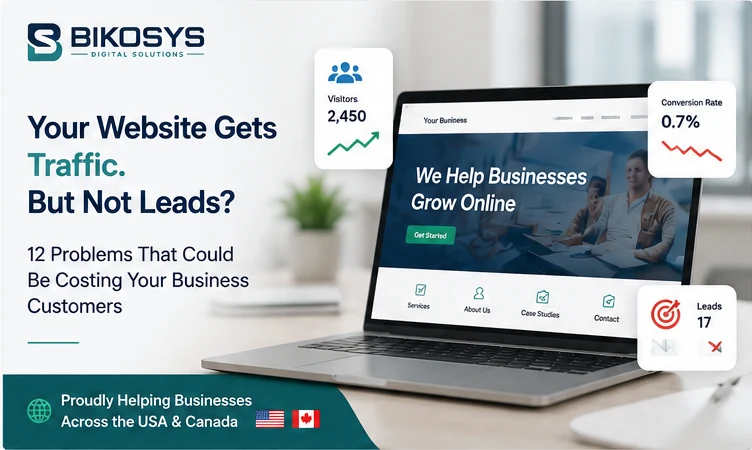
A website can look perfectly respectable and still do very little for the business behind it.
The pages load. The navigation works. Your services are listed. You may even be receiving visitors from Google, referrals, social media or paid advertising.
Yet the inquiries do not come consistently.
When that happens, the first reaction is often, “We need more traffic.”
Sometimes you do. But a website not generating leads is not always suffering from a traffic problem. The wrong visitors may be arriving. Your offer may be unclear. Important service pages may be difficult to discover. Mobile users may be struggling. Trust may be weak. Or the site may be attracting interest without giving people a convincing reason to take the next step.
For businesses in the United States and Canada, where customers often compare several providers before contacting one, those gaps can quietly cost opportunities every day.
Before investing in another redesign, SEO campaign or advertising budget, it is worth understanding why your website is not generating leads and where the customer journey is actually breaking down.
1. Your Website Is Attracting Traffic, but Not the Right Traffic
When a website is not generating leads, traffic volume alone rarely tells the whole story. Not all website traffic has the same business value.
A page can receive hundreds of visits from people looking for definitions, tutorials, free resources, jobs or general information without attracting many people who are actually considering a purchase.
The analytics report may look encouraging because sessions and impressions are increasing. Leads and revenue tell a different story.
The more useful question is not simply, “How many people visited the website?”
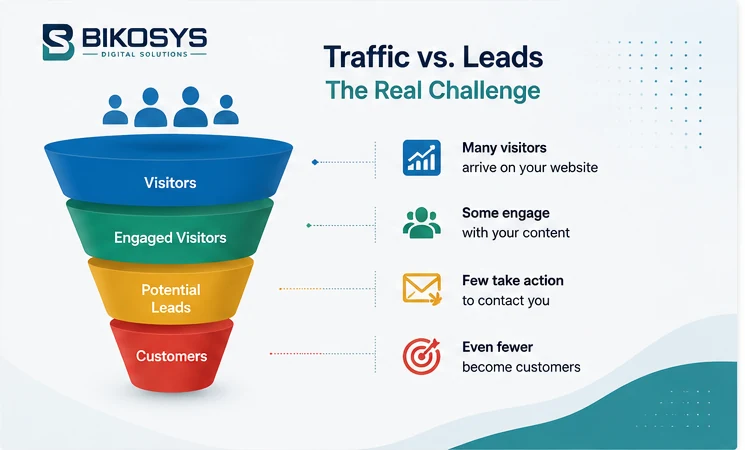
How many of those visitors arrived with a problem our business can solve?
This is where search intent matters. A person researching “what is local SEO?” is at a different stage from someone searching for a local SEO provider for a business in Chicago, Toronto or Vancouver.
Both searches relate to SEO. Only one shows strong commercial intent.
A good organic strategy needs informational content, but it also needs a clear route from that content toward relevant service pages. Our SEO services are structured around that wider journey: search visibility should bring qualified prospects closer to a business outcome, not simply make a traffic graph look larger.
2. Visitors Cannot Understand What You Do Quickly Enough
Open your homepage as if you have never heard of the company.
Ignore the logo. Ignore the About page. Ignore everything you already know about the business.
Within the first few moments, can you answer three questions?
- What does this company do?
- Who is it for?
- Why should I keep reading?
Many websites make these answers unnecessarily difficult.
The hero section contains a clever slogan instead of a useful proposition. Services are described using internal company language. Generic statements such as “empowering your digital journey” may sound polished, but they tell a potential customer almost nothing.
Visitors should not have to decode your positioning.
A strong homepage usually establishes enough relevance for the right visitor to think, “This company understands the problem I have.”
That is one of the key differences between a website that merely looks modern and professional web design services built around customer decisions, usability and conversion paths.
3. Important Service Pages Are Not Visible in Search
When a website is not generating leads, the problem can begin before anybody reaches it. Important service pages may simply not be visible for the searches that matter.
A business may offer six valuable services but explain all of them in a few short sections on one general Services page.
That creates two problems.
- Search engines have very little dedicated information to understand the individual service.
- Customers have very little dedicated information to evaluate whether that service is right for them.
For many companies, well-planned service pages create a stronger structure. A dedicated page can explain the problem, approach, process, benefits, relevant industries, FAQs and next step in much greater depth than a small homepage section.
This becomes even more important when services have different buying intent. A business owner looking for ongoing website support has a different immediate requirement from someone planning a complete ecommerce build.
SEO therefore needs to examine more than keywords. It should also ask whether the website has the right pages to compete for valuable searches in the first place.
SEO cannot properly optimize a commercial page that does not exist.
4. Your Website Looks Fine, but Gives People Little Reason to Choose You
“Professional-looking” is no longer much of a differentiator.
Your competitors probably have professional websites too.
If a buyer in the US or Canada opens five providers and all five appear credible, the next decision is usually based on evidence.
That evidence may include:
- Relevant project examples
- Detailed service explanations
- Testimonials and reviews
- Case studies
- Before-and-after work
- Clear processes
- Industry experience
- Recognisable clients or partners
- Useful guarantees where appropriate
- Real team or business information
The mistake is relying on unsupported claims.
“High quality.” “Best service.” “Industry-leading.” “Customer-focused.”
Almost any competitor can write those words.
Proof is harder to imitate.
If you say you build modern business websites, show the work. If you say you understand ecommerce, explain the decisions involved in building a store that customers can actually use. If you say user experience matters, your own website needs to demonstrate it.
Prospective clients evaluating BIKOSYS can review our website design portfolio rather than relying only on what we say about our capabilities.
The strongest websites do not simply make claims. They make those claims believable.
5. Mobile Visitors Are Getting a Second-Class Experience
A website being “responsive” does not automatically mean it offers a good mobile experience.
Responsive simply means the layout adapts to screen size. A site can technically do that while still being frustrating to use.
Common mobile conversion problems include:
- Oversized hero sections
- Small text
- Buttons placed too close together
- Forms that require excessive typing
- Popups covering most of the screen
- Difficult navigation
- Important information buried too far down the page
- Images dominating the viewport
- Slow-loading scripts
- Layout shifts
- Calls to action disappearing on smaller screens
Think about the context in which someone may discover your business. They could be comparing three contractors, searching for a nearby service, checking a vendor between meetings or browsing on mobile data rather than a fast office connection.
That person does not experience the website the same way somebody does on a large desktop monitor.
Mobile design needs its own judgement. This is also why an SEO-friendly website design should consider usability, information structure, performance and search visibility together instead of treating mobile optimization as a final checkbox before launch.
6. Your Website Is Too Slow at the Moments That Matter
Website speed is often discussed as a technical issue. Google’s Core Web Vitals provide useful measurements for evaluating real-world loading performance, responsiveness and visual stability.
For a customer, it is simply friction.
A prospect clicks a result and waits. They open a service page and wait again. An image appears late and moves the button they were about to select. A form takes too long to load.
None of those visitors is thinking about JavaScript execution, database queries or image compression. They are simply experiencing a website that feels harder to use than it should.
The correct solution depends on the cause. It might involve image optimization, caching, hosting, database cleanup, plugin reduction, script management or deeper development work.
Ongoing website maintenance services can help prevent small technical and performance issues from accumulating until they start affecting customer experience, security or business continuity.
7. Your Service Pages Explain the Service but Do Not Sell the Decision
This is one of the most common weaknesses on business websites.
A service page answers:
“What do we provide?”
But the customer is trying to answer:
“Are these the people I should trust to provide it?”
Those are not the same question.
A commercially useful service page should reduce the uncertainty that appears before someone makes contact.
- What exactly is included?
- Who is the service suitable for?
- What problems does it solve?
- What does the process involve?
- What happens to an existing website or data?
- What should the customer prepare?
- What happens after launch?
- What common mistakes should be avoided?
Good commercial content does more than describe a service. It helps the buyer make a decision.
The call to action then feels like the logical next step instead of an interruption.
8. Your Local Business Is Difficult to Find Where Customers Actually Search
A local service business does not need random visitors from everywhere.
A dentist in Toronto needs patients within a realistic service area. A home-services company in Dallas needs homeowners it can actually serve. A law firm in Vancouver needs qualified local visibility, not simply more global impressions.
For businesses tied to a location or defined service territory, local relevance is commercial relevance.
Customers may discover the company through Google Maps, a Google Business Profile, a location-specific result, a review platform or a service-area page.
The information they encounter across those places should make sense together.
- Business information should be accurate.
- Service details should be consistent.
- Location pages should contain genuine local value.
- Reviews should support trust.
- The landing page should make the next step obvious.
Our local SEO services focus on that full path: helping a business become easier to discover in the locations it genuinely serves while improving the website experience that follows the search.
Ranking locally has limited value if the visitor arrives and still cannot understand why they should choose you.
9. Weak Internal Linking Is Leaving Important Pages Isolated
Internal links are often treated as a technical SEO task.
They are also navigation for customers.
Suppose a visitor reads an article about why an existing website is underperforming. That visitor may naturally need a redesign, SEO support, maintenance, conversion improvements or ecommerce development.
If the article ends without showing a relevant next path, the customer reaches a dead end.
Search engines also use internal links to understand relationships between pages and discover which content appears important within a website.
A website-speed article can support maintenance. A local marketing guide can support local SEO. A conversion article can support web design. An ecommerce guide can lead naturally to ecommerce website development when the reader reaches a problem that requires implementation rather than another piece of advice.
The important word is naturally.
Adding a block of unrelated service links to every article is not a content architecture strategy. The link should appear where the destination genuinely helps the reader continue solving the problem.
10. Your Website Does Not Build Enough Trust Before Asking for Contact
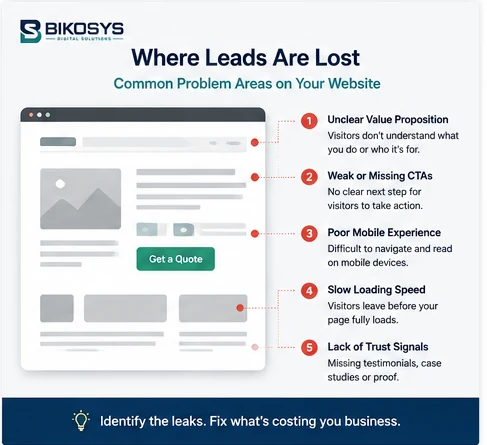
“Contact us” is a bigger request than it looks.
The visitor may be giving you their name, email address, phone number, business details and permission to begin a sales conversation.
Before doing that, they are making a small trust calculation.
- Does this company seem genuine?
- Do they understand my type of problem?
- Is there evidence behind the claims?
- Does the website feel current?
- Can I understand what happens next?
- Will somebody respond professionally?
A weak website asks for commitment before earning confidence.
A stronger website builds confidence progressively through clear copy, useful proof, relevant examples, professional presentation and straightforward contact options.
Before changing the color of the CTA button again, ask a more important question:
Have we given the visitor enough reason to click it?
11. Technical Problems Are Quietly Limiting Search Visibility
Not every SEO problem is visible from the front of a website.
A page may look normal to a customer while search engines encounter a completely different set of problems behind it.
- Important pages blocked from crawling
- Incorrect canonical URLs
- Duplicate versions of pages
- Broken internal links
- Poor redirects
- Incorrect indexing directives
- Sitemap problems
- Weak heading structure
- Complicated site architecture
- Pages with little internal support
- Structured-data errors
- Mobile performance issues
- Old URLs left behind after a redesign
This is why technical SEO should not be reduced to installing a plugin and completing a checklist.
Plugins can manage many elements. They cannot make strategic decisions for the business.
A company that has been online for years may accumulate technical baggage from redesigns, plugins, CMS changes, abandoned landing pages and changing URL structures.
That does not automatically mean the entire website needs rebuilding. It means the underlying problem needs to be diagnosed before choosing the solution.
For some sites, focused technical SEO is enough. For others, the underlying structure requires website development services rather than another temporary patch.
12. You Keep Fixing Individual Problems When the Website Itself Has Reached Its Limit
There comes a point where another plugin, another banner or another CSS adjustment stops being the sensible answer.
Perhaps the website was built many years ago. The company has changed direction. Navigation no longer reflects the services you sell. The CMS is difficult to manage. Mobile layouts require constant fixes. Or the site has accumulated so many disconnected patches that improving one area creates another problem.
At that stage, continuing to repair individual symptoms can become more expensive than addressing the underlying system.
But that still does not automatically mean “build a completely new website.”
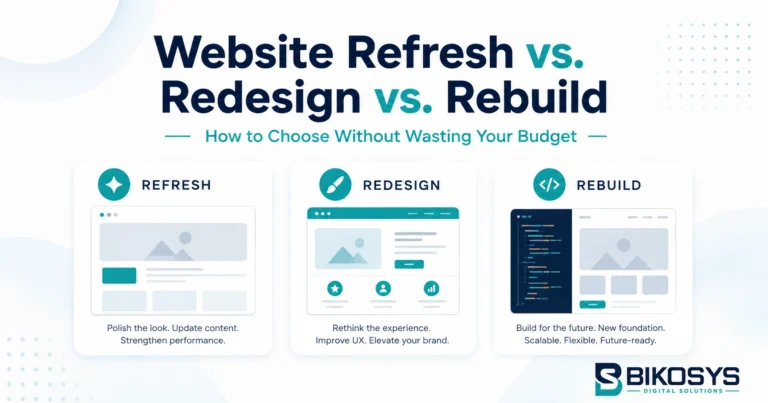
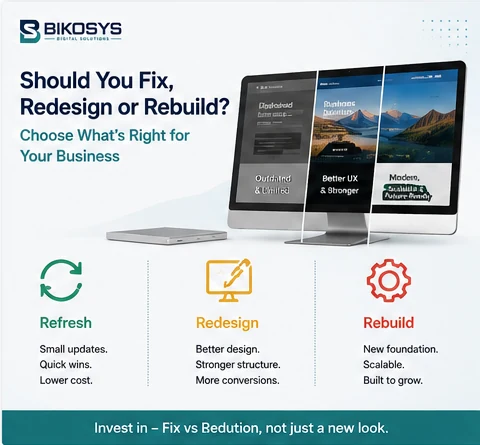
Website Refresh
A refresh is appropriate when the foundation remains healthy but parts of the presentation, content, imagery or user experience need improvement.
Website Redesign
A redesign is appropriate when the visual system, navigation, page hierarchy or conversion journey needs substantial improvement while valuable parts of the existing website can remain.
Website Rebuild
A rebuild becomes more appropriate when the underlying technology, code, CMS or architecture has become part of the problem.
We explain this decision in greater depth in our guide to whether you should refresh, redesign or rebuild your website.
The important principle is diagnosis before replacement.
SEO Problem, Website Problem, or Both?
One reason underperforming websites stay underperforming is that businesses sometimes invest in the wrong solution.
They buy more SEO when the website cannot convert. They redesign a site whose biggest problem is lack of visibility. They run advertising to a weak landing page. They rewrite copy when the real issue is technical.
The symptoms below can help indicate where to look first.
| What You Are Seeing | What May Be Wrong | What to Investigate First |
|---|---|---|
| Very little organic traffic | Search visibility problem | SEO, indexing, content and competition |
| Good traffic but almost no inquiries | Conversion or intent problem | Traffic quality, messaging, UX and CTA |
| Good rankings but poor-quality leads | Search-intent mismatch | Keywords and landing-page relevance |
| Local competitors dominate Maps | Local visibility problem | Google Business Profile and local SEO |
| Mobile conversions are much weaker | Mobile UX or performance issue | Responsive layout, speed and forms |
| Traffic fell after a redesign | Migration or technical SEO issue | Redirects, indexing, canonicals and lost content |
| Site looks dated and converts poorly | Design and positioning issue | UX, messaging, trust and redesign |
| Pages are slow or frequently break | Technical or maintenance issue | CMS, plugins, hosting and code |
| Store gets visits but few purchases | Ecommerce conversion issue | Product pages, navigation, checkout and trust |
| Publishing more content changes little | Structural or authority problem | Content quality, architecture, internal links and backlinks |
Quite often the answer is both.
SEO gets the right person to the website. Design, content, usability and trust help that person make a decision.
Separating those responsibilities too aggressively can create a website that ranks but does not sell, or a beautiful website nobody discovers.
Should You Get More Traffic or Improve the Website First?
There is no universal answer.
If only a small number of highly relevant people visit the site each month, conversion optimization alone cannot create enough opportunities. The business needs greater qualified visibility.
If a large number of relevant prospects already visit and almost nobody contacts the company, your website is not generating leads from the traffic it already has. Buying more traffic may simply make the leak larger.
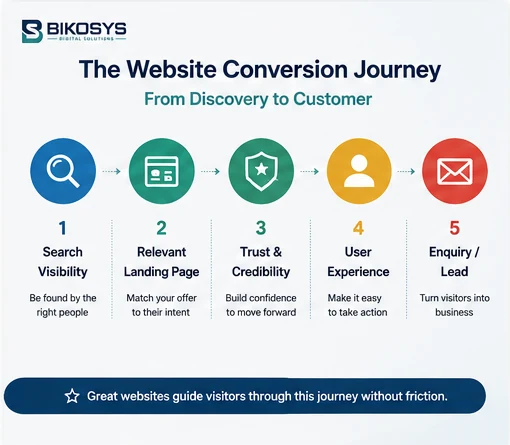
Look at the sequence:
Visibility → Relevance → Trust → Evaluation → Action
Where are people disappearing?
That is where the next investment should begin.
When Does Website Redesign Become the Right Choice?
A redesign becomes worth considering when several problems are connected to the website’s structure and experience rather than one isolated issue.
- The website no longer reflects the business you have become.
- Important services are difficult to discover.
- Mobile usability is consistently poor.
- Conversion paths are confusing.
- The design visibly damages credibility.
- Updating content is unnecessarily difficult.
- Multiple technical patches have accumulated.
- SEO improvements require major structural changes.
- Competitors provide a substantially better digital experience.
- The current platform prevents important functionality.
Professional website redesign services should begin by deciding what deserves to be preserved.
Existing rankings, useful content, backlinks, established URLs and conversion data should not be thrown away simply because the visual design is changing.
A redesign is not a reset button.
Handled correctly, it is an opportunity to keep what already has value while removing what is holding the business back.
What About Ecommerce Websites?
For an ecommerce business, “not generating leads” often appears as a different problem:
People browse, but they do not buy.
That requires looking at the complete purchasing journey.
- Can shoppers find the right product quickly?
- Are categories logical?
- Do product pages answer buying questions?
- Are images convincing?
- Is pricing clear?
- Can customers understand delivery and returns?
- Does the store feel trustworthy?
- Does checkout introduce unnecessary friction?
- Does the experience work properly on a phone?
- Can search engines understand product and category pages?
Strong ecommerce website development needs to treat the store as a selling system rather than a product catalog connected to a payment gateway.
The prettier storefront does not automatically win.
The easier buying experience often does.
Why Is Your Website Not Generating Leads? Start With These Checks
You do not need to redesign the website tomorrow.
Start with evidence.
Review Your Highest-Traffic Pages
Which pages receive attention, and what useful action should somebody take from each one?
Review Your Highest-Value Service Pages
Can a new visitor understand the service without already knowing the company?
Test the Website on an Actual Phone
Do not rely only on shrinking a desktop browser. Use the site in the conditions a real customer would.
Submit Your Own Forms
Check the entire experience, including confirmation messages and what happens after the form is submitted.
Search for Your Core Services
Which pages appear? What are competitors doing better? Is your result aligned with the searcher’s actual intent?
Examine the Path Between Blog Content and Commercial Pages
Can an informational visitor naturally progress toward a relevant service, or does each blog post end as an isolated piece of content?
Check Whether Important Pages Are Indexed
A published page and an indexed page are not always the same thing. Verify that important service pages are actually discoverable in search.
Look at the Business Through a Stranger’s Eyes
This is often the hardest step.
Business owners know too much about their own companies. Customers arrive knowing almost nothing.
Your website has to close that gap.
A Website Should Be a Customer-Acquisition Asset, Not an Online Brochure
A website does not need to become the company’s only source of leads.
But if you are investing in it, it should contribute something meaningful to the business.
- More qualified inquiries
- Better organic visibility
- Stronger local discovery
- Higher ecommerce sales
- Better lead quality
- Greater trust before a sales conversation
- Lower dependence on paid advertising
- Easier customer education
- Stronger positioning against competitors
The objective is not more design for the sake of design.
It is not more content for the sake of content.
And it is not more traffic simply so the analytics graph goes upward.
The objective is to build a clearer path between being discovered and being chosen.
If your website is not generating leads despite attracting relevant visitors, there is usually an identifiable reason somewhere between visibility, relevance, trust, user experience and conversion.
Finding that reason is far more valuable than guessing at the next fix.
Frequently Asked Questions
Why is my website getting traffic but no leads?
If your website is not generating leads despite receiving traffic, the visitors may have low commercial intent, the landing page may not match what they searched for, the offer may be unclear, or the website may lack the trust and usability required to turn interest into action.
How can I make my website generate more leads?
Start with the areas closest to the buying decision: clear service messaging, relevant landing pages, strong calls to action, proof and trust signals, mobile usability, page speed and straightforward forms. SEO can then increase qualified visibility for those stronger pages.
Should I redesign my website if it is not generating leads?
Not automatically. A redesign makes sense when the problems are connected to layout, structure, usability, branding or technology. If the website is fundamentally strong but receives little qualified traffic, SEO may be the higher priority. Diagnose the cause before committing to a rebuild.
Can SEO increase website leads?
SEO can increase leads when it attracts people searching for services or solutions the business actually provides and directs them to relevant pages. Rankings and traffic alone are not enough; the landing experience also needs to convert that demand into inquiries.
How do I know whether my website problem is SEO or web design?
If very few relevant people reach the site, investigate SEO and visibility first. If qualified visitors already arrive but rarely take action, investigate messaging, user experience, trust and conversion paths. Many underperforming websites have elements of both problems.
How often should a business website be reviewed?
A website should be reviewed regularly rather than waiting until something visibly breaks. Content, competitors, software, search behavior, customer expectations and business priorities change over time. Major redesigns may be occasional, but performance, security, content and conversion checks should be ongoing.
Not Sure What’s Stopping Your Website From Generating Leads?
Your website may not need a complete rebuild. The real issue could be search visibility, service-page structure, mobile usability, performance, trust, conversion paths or an outdated design that no longer reflects the business.
BIKOSYS works with businesses across the United States and Canada on web design, website redesign, SEO, ecommerce development, WordPress development and ongoing website support. We can review the existing website, identify the highest-impact problems and recommend a practical next step.